

The Imitation Game
In his 1950 paper ‘Computing Machinery and Intelligence’, Alan Turing began with the question ‘Can machines think?’, but, finding it ‘too meaningless to deserve discussion’, instead proposed his ‘imitation game’, more often called the Turing test, to pass which a computer would have to be indistinguishable from a human on the basis of its replies to a series of questions.1 What the paper seeks to answer instead, therefore, is ‘Are there imaginable digital computers which would do well in the imitation game?’ He believes the answer is yes and that in the not too distant future ‘one will be able to speak of machines thinking without expecting to be contradicted’.2 OpenAI released ChatGPT in November 2022, and a year later its CEO Sam Altman made an observation that has since become a commonplace: ‘the turing test went whooshing by and everyone mostly went about their lives’. This means either we’re back, in effect, to asking the question Turing rejected – ‘But is ChatGPT actually thinking?’ – or we must come up with better questions. I believe doing so should begin with something Turing does not address, namely the nature of what is being imitated, or, in other words, what it is to be human.
Fair enough for him not to address it, one might say; such a philosophical question does not deserve discussion in an article about computers (though it was published in Mind). The closest Turing gets to humanistic considerations is to quote, in order to argue against, the neurosurgeon Geoffrey Jefferson, who said, ‘Not until a machine can write a sonnet or compose a concerto because of thoughts and emotions felt, and not by the chance fall of symbols, could we agree that machine equals brain’.3 This Turing labels ‘The Argument from Consciousness’. And just as I think he outs himself as a blank-slatist when he compares a child’s brain to a notebook,4 I cheerfully out myself as a squishy humanist when I say that Jefferson was right then and is right still that machine ≠ brain. No matter how well a stick insect imitates a stick, the nature of the latter remains a separate question. The name’s consciousness. Hard problem of consciousness.
This essay proposes, now that we’re living with AI, to check in with the ancient question of human nature, with the expectation that doing so will tell us about what AI might yet do and about ourselves.
The Imagination Game
In 1926, a quarter of a century before Turing’s paper, when he himself was just fourteen, the Irish writer Elizabeth Bowen published a short story, ‘The Visitor’, in which she coined another term for another game, and a harder one for a computer to play. The story begins like this:
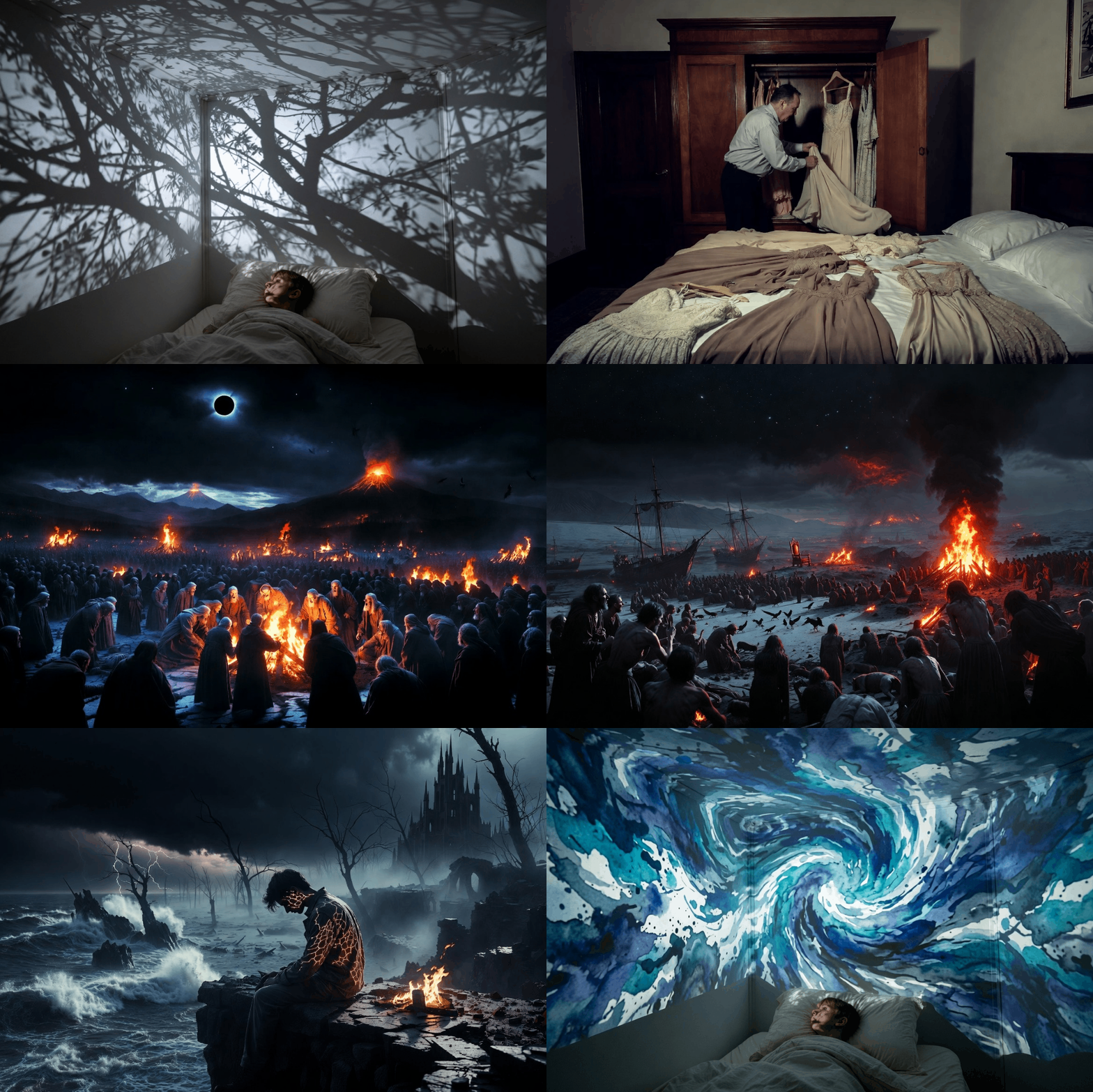
Roger was awakened early that morning by the unfamiliar sound of the trees in the Miss Emerys’ garden. It was these that had made the room so dark the previous evening, obscuring the familiar town lights that shone against the wall above his bed at home, making him feel distant and magnificently isolated in the Miss Emerys’ spare-room. Now, as the sky grew pale with sunless morning, the ceiling was very faintly netted over with shadows, and when the sun washed momentarily over the garden these shadows became distinct and powerful, obstructive; and Roger felt as though he were a young calf being driven to market netted down in a cart. He rolled over on his back luxuriously, and lay imagining this.
But the imagination-game palled upon him earlier than usual, defeated by his returning consciousness of the room. Here was he alone, enisled with tragedy.5
To be conscious of being isolated with tragedy. Machines are no closer to this than they were in 1950 and they will be no closer in 2050. To quote Jefferson, ‘No mechanism could feel (and not merely artificially signal, an easy contrivance)’.6 And have you ever got something to pall upon a chatbot? No, they unmask themselves by their deadly and infinite breeziness.
Bowen returned to the idea of an imagination game in an essay of 1941 called ‘Children’s Play’, about the Brontës and their ‘Gondal saga’, the imaginative world created by Emily and Anne. Bowen is here thinking not about an isolated child’s imagination but about imagination networked. She is clearly no believer in the blank slate, though as a woman of her time she has a chatbot’s liking for em rules:
How much does creative imagination owe to its domination by a first fantasy? One fantasy—sometimes simple, sometimes complex in form—may be found at the root of any one artist’s art. The greater—that is to say, the more vital, powerful and expansive—the art, the more ingrowing, in most cases, the fantasy. Often the fantasy is a private dream, to which the imagination returns and attaches itself with an almost voluptuous energy. Almost all people have had such dreams, or day-dreams, and with each person the dream, though remaining the same in essence, is capable of a number of variations—in childish friendships such dreams are pooled, shared and developed, and ‘imagination-games’ are the result.7
Are there imaginable imaginational computers which would do well in such games? In the spirit of Turing’s article, let’s look ahead.
At one point Turing addresses the view that a computer could ‘never do anything really new’:
This may be parried for a moment with the saw, ‘There is nothing new under the sun’. Who can be certain that ‘original work’ that he has done was not simply the growth of the seed planted in him by teaching, or the effect of following well-known general principles. A better variant of the objection says that a machine can never ‘take us by surprise’.8
The metaphor of a seed, like that of a notebook, is casually reductive of the mind. According to the distinction famously elaborated by Coleridge, Turing attributes to us, and in potentia computers, the faculty of fancy, but appears to doubt the existence of the imagination, through which a person can ‘do something really new’. In his Biographia Literaria, Coleridge writes,
The imagination then I consider either as primary, or secondary. The primary imagination I hold to be the living power and prime agent of all human perception, and as a repetition in the finite mind of the eternal act of creation in the infinite I ᴀᴍ. The secondary I consider as an echo of the former, coexisting with the conscious will, yet still as identical with the primary in the kind of its agency, and differing only in degree, and in the mode of its operation. It dissolves, diffuses, dissipates, in order to recreate; or where this process is rendered impossible, yet still at all events it struggles to idealize and to unify. It is essentially vital, even as all objects (as objects) are essentially fixed and dead.
Fancy, on the contrary, has no other counters to play with, but fixities and definites. The fancy is indeed no other than a mode of memory emancipated from the order of time and space; and blended with, and modified by that empirical phenomenon of the will, which we express by the word choice. But equally with the ordinary memory it must receive all its materials ready made from the law of association.9
Fancy is perhaps not merely ‘the chance fall of symbols’,10 as Jefferson put it, but is it any more than the rearranging of them? If LLMs are trained on pre-existing corpora and datasets – ‘fixities and definites’ – they presumably know of the collective conscious but not the collective unconscious, from which dreams arise. The secondary and primary imagination, on the other hand, I would suggest are, respectively, ways of thinking about the possibilities of artificial general intelligence (AGI) and superintelligence (ASI). An AGI would have the synthetic capacity to dissolve, diffuse, dissipate, in order to create something really new, and thereby transform debates about AI art; and an ASI would no doubt find many willing worshippers, the word ‘superintelligence’ having been coined in the early nineteenth century as a name for God.
I do not think AI currently possesses imagination, but it does do… strange things. Returning to Turing, there is the question of surprise. ‘Machines’, he writes, ‘take me by surprise with great frequency’,11 and many people have found this to be true of the chatbots we now habitually use. For example, before I’d located Bowen’s story ‘The Visitor’, all I had was the OED’s entry for ‘imagination-game’. I asked Grok, ‘Elizabeth Bowen in “Ann Lee’s and Other Stories” (1926): “But the imagination-game palled upon him.” What does “the imagination-game” mean here?’ And it told me about a completely different Bowen story called ‘Making Arrangements’, in which the phrase ‘imagination-game’ does not in fact appear:
“The imagination-game” refers to the husband’s (Hewson Blair’s) solitary, increasingly obsessive fantasy or make-believe involving his estranged wife’s abandoned clothes and the emotional/sexual life they once represented.
In the story “Making Arrangements” (from Ann Lee’s and Other Stories, 1926), Hewson is a practical, unimaginative man whose flighty wife Margery has left him for another man. She asks him to “make all arrangements” for their divorce and to pack/send her clothes. Alone in her bedroom, Hewson opens her wardrobe and is startled by the dresses, which seem to leap out with her vitality (“From the dusk within, cedar-scented and cavernous, Margery leapt out at him”).
He then engages in an intense, ritualistic interaction with them—touching, ripping, laying them out, and imagining them as infused with her “irrepressible palpitation” and “provocative” presence. This escalates into a mix of violence, desire, and substitution: the real Margery is replaced by a spectral, phantom version evoked through her garments. The “imagination-game” is this private, immersive fantasy play that briefly engages him but ultimately “palled upon him” (grew boring or tiresome). It highlights his repressed emotions, the gap between his intentional but un-imaginative nature and the vivid life Margery brought, and themes of loss, objectification, and gothic substitution common in Bowen’s early work.
This is what gets called a hallucination, but in a sense that phrase itself ‘begs the question’, as philosophers say; that is, it assumes an answer to the question Turing thought meaningless, ‘Can machines think?’, since ‘hallucinate’ is from the Latin for ‘gone astray in thought’. Grok certainly went evocatively astray, but perhaps in finding its answer evocative I am indulging in pareidolia, the perception of significance in random arrangements. The answers of chatbots are rather like the ‘wave poem’ in Knapp and Michaels’s famous thought experiment in ‘Against Theory’:
Suppose that you’re walking along a beach and you come upon a curious sequence of squiggles in the sand. You step back a few paces and notice that they spell out the following words:
    A slumber did my spirit seal;
       I had no human fears:
    She seemed a thing that could not feel
       The touch of earthly years.
[…] Are these marks mere accidents, produced by the mechanical operation of the waves on the sand (through some subtle and unprecedented process of erosion, percolation, etc.)? Or is the sea alive and striving to express its pantheistic faith?12
Only in the latter case, the authors argue, would the marks be words expressing meaning, since there is no such thing as ‘intentionless meanings’. It would appear that Grok’s false yet intriguing account of ‘Making Arrangements’ is a mere accident produced by mechanical operations. But, leaving aside whether an AI could be alive and strive to express its pantheistic faith, are there imaginable AIs with intention?
What could be intended, for example, by ‘gothic substitution’. You have to hand it to Grokkers, it’s a good phrase, and one that suggests another new test or game. I’ve often thought that, with its lack of smoothness and symmetry, the Gothic is something of an antidote to AI, but could AI ever become Gothic? We have Victorian Gothic and Southern Gothic – what would AI Gothic be like?
In The Analysis of Beauty William Hogarth asks, ‘Have not many gothic buildings a great deal of consistent beauty in them? perhaps acquired by a series of improvements made from time to time’.13 Byron provides an affirmative answer in his description of ‘the Gothic pile’ (XIII. 465) ‘Norman’ (Newstead) Abbey, in Don Juan:14
Huge halls, long galleries, spacious chambers, join’d
By no quite lawful marriage of the Arts,
Might shock a Connoisseur; but when combined,
Form’d a whole which, irregular in parts,
Yet left a grand impression on the mind,
At least of those whose eyes are in their hearts.
We gaze upon a Giant for his stature,
Nor judge at first if all be true to Nature. (XIII. 529–36)
This could be a description of the improvised structure of Don Juan itself – famously Byron said to his publisher, ‘I have no plan – I had no plan; but I had or have materials’.15 At the end of Canto II he projected ‘twelve, or twenty-four’ cantos (II. 1725) and once joked about writing fifty.16 In the event he only got to the beginning of the seventeenth before he died. The final stanza reads,
Which best is to encounter—Ghost, or none,
’Twere difficult to say—but Juan looked
As if he had combated with more than one,
Being wan and worn, with eyes that hardly brooked
The light, that through the Gothic windows shone:
Her Grace, too, had a sort of air rebuked—
Seemed pale and shivered, as if she had kept
A vigil, or dreamt rather more than slept. (XVII. 105–12)
And this is where it is hard to imagine a true AI Gothic, because Don Juan’s irregularity, which leaves a grand impression on the mind, is wrapped up with the mortality of its author. Chatbots sometimes fail to generate an answer or image, but I haven’t seen one die part-way through in a meaningfully aesthetic way, or, as Jefferson puts it, ‘feel […] grief when its valves fuse’.17
I cannot yet imagine an AI writer whose work I would want to read despite knowing it was but an imitation of life. But perhaps a time will come when an artificial intelligence will be capable of playing the imagination game and thereby truly turning the world back into what it was for our ancestors, a terra incognita. To pass my test a computer would have to give good answers to Ballardian questions such as ‘what do you dream about?’, ‘what lies beyond total alienation?’, and ‘where would you like to be when the world ends?’18 If you ask such questions of your chatbot of choice I’m almost certain its answers will underwhelm you. Byron’s, on the other hand, you might find astonishing. So I’ll close by quoting the beginning and end of his post-apocalyptic poem ‘Darkness’, and with the speculation that to imagine the end of the world one has to be capable of imagining the end of oneself:
I had a dream, which was not all a dream.
The bright sun was extinguish’d, and the stars
Did wander darkling in the eternal space,
Rayless, and pathless, and the icy earth
Swung blind and blackening in the moonless air;
Morn came, and went—and came, and brought no day,
And men forgot their passions in the dread
Of this their desolation; and all hearts
Were chill’d into a selfish prayer for light:
And they did live by watchfires—and the thrones,
The palaces of crowned kings—the huts,
The habitations of all things which dwell,
Were burnt for beacons; cities were consumed,
And men were gathered round their blazing homes
To look once more into each other’s face;
Happy were those who dwelt within the eye
Of the volcanoes, and their mountain-torch:
A fearful hope was all the world contain’d;
Forests were set on fire—but hour by hour
They fell and faded—and the crackling trunks
Extinguish’d with a crash—and all was black. […]
The rivers, lakes, and ocean all stood still,
And nothing stirred within their silent depths;
Ships sailorless lay rotting on the sea,
And their masts fell down piecemeal; as they dropp’d
They slept on the abyss without a surge—
The waves were dead; the tides were in their grave,
The moon their mistress had expired before;
The winds were withered in the stagnant air,
And the clouds perish’d; Darkness had no need
Of aid from them—She was the universe. (1–21, 73–82)
A. M. Turing, ‘Computing Machinery and Intelligence’, Mind, 59, 236 (1950), 433–60 (pp. 433, 442).
Turing, p. 442.
Turing, p. 445.
Turing, p. 456.
Elizabeth Bowen, Ann Lee’s and Other Stories (Freeport, NY: Books for Libraries, 1926), p. 53.
Turing, p. 446.
Elizabeth Bowen, Collected Impressions (New York: Alfred A. Knopf, 1950), p. 144.
Turing, p. 450.
H. J. Jackson, ed., Samuel Taylor Coleridge: The Major Works (Oxford: Oxford University Press, 2000), p. 313.
Turing, p. 445.
Turing, p. 450.
Steven Knapp and Walter Benn Michaels, ‘Against Theory’, Critical Inquiry, 8, 4 (1982), 723–42 (pp. 727–28).
Ronald Paulson, ed., William Hogarth: The Analysis of Beauty (New Haven, CT: Yale University Press, 1997), p. 46.
Jerome J. McGann, ed., Lord Byron: The Major Works (Oxford: Oxford University Press). All quotations from Byron’s poetry are taken from this edition.
Leslie A. Marchand, ed., Byron’s Letters and Journals, 12 vols (London: John Murray, 1973–94), VI, pp. 207–208.
Marchand, ed., VI, pp. 105–06.
Turing, p. 446.
J. G. Ballard, The Complete Short Stories of J.G. Ballard (New York: Norton, 2009), pp. 677, 72.