


Like many people, I group my books into broad categories: poetry, novels and plays, academic, reference, books I teach. But here I want to discuss another, special genre whose single criterion for inclusion makes it highly selective. It comprises only a fraction of one per cent of my books. I refer to the genre of small. Physically small books. Not Penguin Classics, no. Smaller than that.
I have a bookcase which holds three rows of books, one on the base and two above on adjustable shelves – adjustable by the moving of metal pins into holes at various heights. Hoping to use the space efficiently, I positioned the lower adjustable shelf so that most of my largish reference books could be accommodated on the lower two rows. But this meant that the second of the two adjustable shelves had to be put at the very highest position, leaving clearance of just over seven inches, enough space for the books variously known as A-format, mass-market, and, in America, pocket books. This is the size of the original Penguin paperbacks, later revived as Penguin Popular Classics – you might remember these as the bright-green books you could buy for £2, around fifteen or twenty years ago. But the joy of the small genre – works with nothing in common but their height – is not uniformity, it is its serendipitous, collage-like character. On a shelf dedicated to smallism, book calls to book across every sociocultural divide.
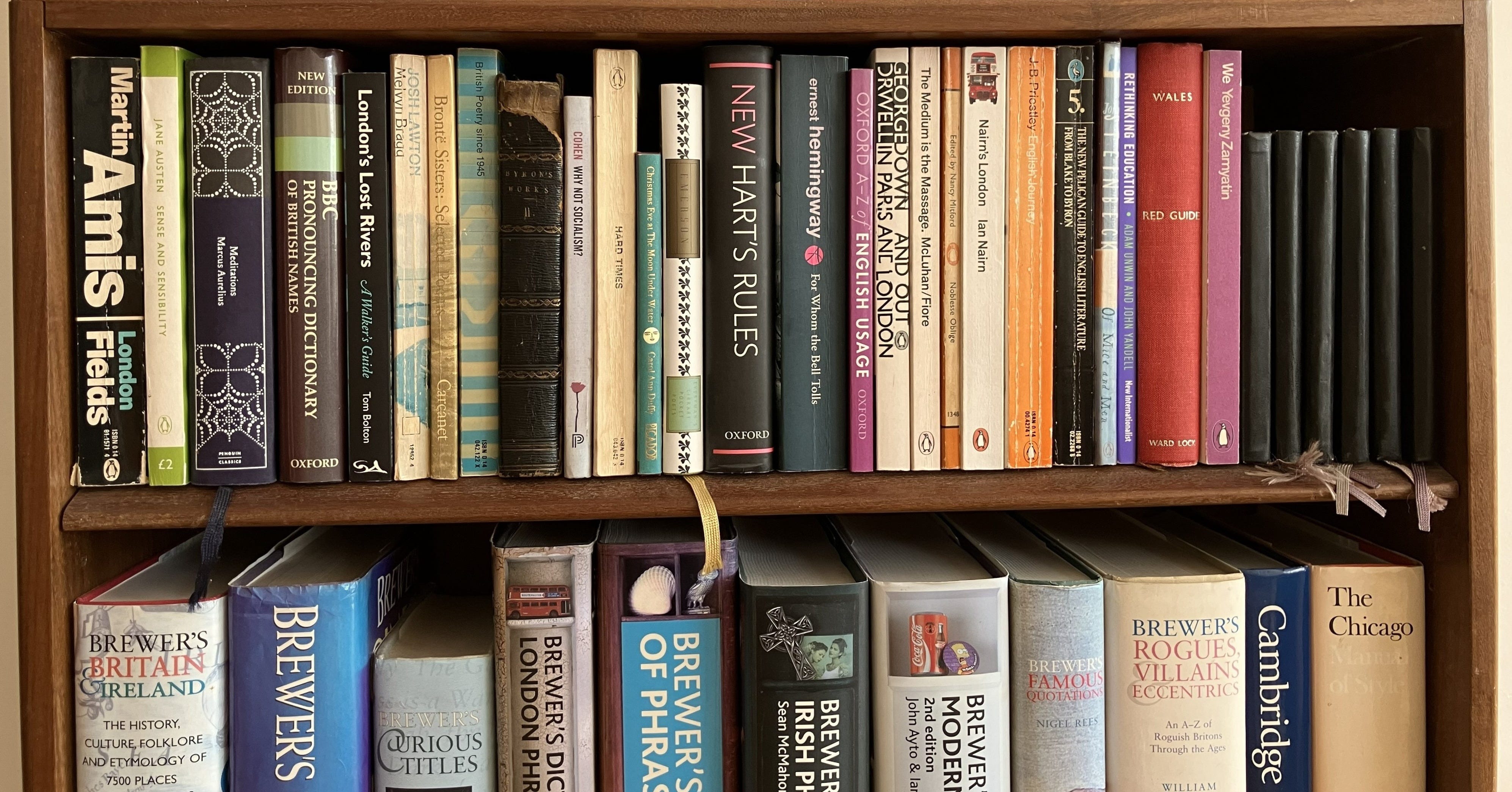
London Fields by Martin Amis, a mass-market paperback, published in 1990, the year after the first edition. A dense, soot-blackened London stock brick of a book. A cuboid straight out of the wall of the Black Cross.
Sense and Sensibility is all the go thanks to the new film, out next week. In his essay on Austen, ‘Force of Love’, Amis praises what she is capable of doing in the highest terms, and ends the paragraph with the critic’s fundamental question: ‘How?’ This Sense and Sensibility is one of the aforementioned Penguin Popular Classics, so beware tiny type.
The Meditations of Marcus Aurelius, a hardback Penguin and a gift from a friend. Book the first, meditation the first: ‘decency and a mild temper.’
The BBC Pronouncing Dictionary of British Names. I bought this and then found another copy in my grandad’s study. Essential for ‘the pleasant, unobtrusive speaker who does not distract attention from his subject matter by causing embarrassment, unwitting amusement, or resentment among intelligent listeners.’ Very much out of print.
London’s Lost Rivers by Tom Bolton. Another gift. My favourite chapter is on the Wandle, which, as the author admits, is hardly lost, given that you can walk beside it on a very nice trail while it floweth evermore from Croydon to Wandsworth.
For Whom the Bell Tolls, a novel I doubt I’d have enjoyed even had I been able to read it without the use of a magnifying glass.
Josh Lawton, one of Melvyn Bragg’s Cumbrian novels, published 1972, which I read because I share the hero’s name. The stillness passed ‘to that central self which had always sustained him so serenely and now pulsed with anticipated joy.’
The Brontë Sisters: Selected Poems, edited by Stevie Davies, one of my grandad’s books. ‘No coward soul is mine / No trembler in the world’s storm-troubled sphere / I see Heaven’s glories shine / And Faith stands equal arming me from Fear’ (Emily Brontë). This is the poem Emily Dickinson had read at her funeral.
A first edition Byron, specifically a pirated edition ‘comprehending all his suppressed poems’, published in Paris in 1818. A precious gift containing two of my favourites, ‘Darkness’ and Manfred.
Why Not Socialism? by G. A. Cohen. I remember thinking about this book while on a bike ride in 2017 in the Outer Hebrides.
Christmas Eve at the Moon Under Water by Carol Ann Duffy, a small book even by the standards of smallism, and deriving its title from Orwell’s favourite Wetherspoon’s.
There’s a strand of correctitude among small books. Not only the BBC Pronouncing Dictionary, but also Hart’s Rules and an A–Z of English Usage. Plus Nancy Mitford’s Noblesse Oblige, the book that popularised ‘U and non-U’. Smallism is inclusive but also elitist. Any author can be admitted, but only if they fit in.
As at a good party, the small books on this shelf ask each other interesting questions. Mitford has little patience with the question Why Not Socialism?, but Cohen gets the time of day from my PGCE tutor, co-author of Rethinking Education: Whose Knowledge Is It Anyway?, and perhaps from the Orwell of Down and Out in Paris and London, not yet politicised but open to persuasion. His later essay on Dickens says, of Hard Times (next-door to Cohen), ‘There is not a line in the book that can properly be called Socialistic’.
J. B. Priestley, on the other hand, is if anything too socialistic. In 1949, one and a half pills after Down and Out, Orwell called him a ‘Strong sympathiser’ with the Soviet Union. ‘Why not communism?’
The Medium is the Massage says Marshall McLuhan. Very much, and the medium of smallism is ᴄᴏᴍᴘʀᴇssɪᴏɴ and ℂ𝑜𝓁Ⓛ𝔞𝒢𝐄.
Nairn’s London, one of the best books about London and certainly the smallest. On walking the Grand Union Canal: ‘Even a short sample is enough to get you hooked on the neglected world of industrial landscape. After it, everything else seems a bit pallid.’
From Blake to Byron, a Pelican; that is, of the imprint for non-fiction launched by Penguin in 1937. A book about Romanticism but which calls Byron an ‘anti-romantic’. It quotes his statement against pallidity – ‘The great object of life is sensation’ – but sadly says nothing about ‘Darkness’ or Manfred.
Of Mice and Men, Steinbeck’s superb ‘play-novelette’, an out-of-place teaching book, and boon companion, lo these many years, of Priestley’s wretched An Inspector Calls.
We by Yevgeny Zamyatin, the Russian novel that inspired Nineteen Eighty-Four (though it’s more Kafkan than the Anglo-American dystopias).
And finally, six years of fun-filled Moleskine diaries over whose contents we must draw a veil.
Happily, like any gladdening bookshelf this one contains a few volumes swelling the ranks of the unread: British Poetry Since 1945, an edition of Emerson, the Red Guide to Wales. So it only remains to say, as E. F. Schumacher put it, recapitulating Burke: small is beautiful.
A very enjoyable read Josh. Some people arrange their books in groups of colours…. difficult and rather odd but visually pleasing.