
1.
Writing emerged in Mesopotamia some time in the late fourth millennium ʙᴄ. Its earliest use was in the making of lists.
2.
The Bible contains a variety of lists, including what biblical scholars call ‘ethical lists’, such as the Ten Commandments, eight shalt-nots and two positive directives: ‘Remember the sabbath’ and ‘Honour thy father and thy mother’ (Exodus 20: 8–12).
3.
Around 1584, William Cecil, Elizabeth I’s chief minister, wrote his own list of ‘ten precepts’ for his son: ‘next unto Moses’ tables, if thou imprint them in thy mind, thou shalt reap the benefit’. It is said that these were the inspiration for Polonius’s advice to Laertes in Hamlet: ‘Give thy thoughts no tongue, / Nor any unproportioned thought his act’ (I. iii. 62–63), etc.
4.
There are books that are lists of lists: The Book of Lists (1977) by David Wallechinsky et al. and The Infinity of Lists (2009) by Umberto Eco. Reality Hunger (2010) by David Shields is a single 618-point list. It’s a bit like a book-length version of Oscar Wilde’s preface to The Picture of Dorian Gray, except that the nascent ‘artistic movement’ of which it treats sounds like the opposite of Wildean aestheticism: ‘in order to be a truly good artist, you need to link your art to your life’ (221). Some other examples:
52. Modernism ran its course, emptying out narrative. Novels became all voice, anchored neither in plot nor circumstance, driving the storytelling impulse underground.
63. Only those who keep faithful diaries will know what they were doing at this time, on this day, a year ago.
65. The lyric essayist seems to enjoy all the liberties of the fiction writer, with none of a fiction writer’s burden of unreality[.]
180. Nonfiction writers imagine. Fiction writers invent.
200. I make it real by putting it into words.
278. User-made content is the new folk art.
287. Reality is what is imposed on you; realness is what you impose back.
Number eight inspired this list: ‘The earliest uses of writing were list-making and account-keeping.’
5.
Lists are linear and, as such, epitomise writing. Contrast the dreaded mind map. Asyndetic lists are best – they’re more listy.
6.
I should like to write a short memoir called My Life in Lists. I measure out my life in lists, and lists of lists. Because they impose order, I guess.
7.
You do too, at least to some extent. Diaries are fractal lists: you know of what each day, week, month consists; you measure out your life in lists.
8.
The Oxford English Dictionary says that ‘listless’ means ‘marked by languid indifference […] as to what one has to do’ (my emphasis). So ‘listless’ = ‘to-do-listless’. And yet the most important thing about items on a to-do list is doneness, at which point you’re listless once more. (Everyone’s to-do list has the same first and last items. Item number one, to quote the opening to David Copperfield: ‘ɪ ᴀᴍ ʙᴏʀɴ’.)
9.
The best lists are reading lists. I heard someone on Desert Island Discs – I can’t remember who – say that to do an English degree is to get a reading list for life. I like this, the way a book can wait on the shelf for years until you’re ready for it. I had this with Oliver Goldsmith’s The Vicar of Wakefield.
Incidentally, list of English authors to have produced a major long poem, a major play, and a major novel:
Oliver Goldsmith
Er, that’s it.
Desert Island Discs is itself a list of eight. Today, excluding Morrissey and Bob Dylan, to give everyone else a chance, mine are:
Cigarettes After Sex, ‘The Night Train’
Gram Parsons, ‘Streets of Baltimore’
The Velvet Underground, ‘Ride into the Sun’ (the version on Another View)
The Chameleons, ‘Swamp Thing’
Elvis, ‘Kentucky Rain’
The Jam, ‘Down in the Tube Station at Midnight’
Johnny Cash, ‘First Time Ever I Saw Your Face’
King Hannah, ‘It’s Me and You, Kid’
10.
But more to the point, what about Desert Island Lists? Don’t choose the Ten Commandments or Polonius’s precepts, because you get them in the Bible and the Complete Works of Shakespeare. Mine are:
1. Spenser’s ‘sylva’, or catalogue of trees, in The Faerie Queene:
The sayling Pine, the Cedar proud and tall,
The vine-propp Elme, the Poplar neuer dry,
The builder Oake, sole king of forrests all,
The Aspine good for staues, the Cypresse funerall.The Laurell, meed of mightie Conquerours
And Poets sage, the Firre that weepeth still,
The Willow worne of forlorne Paramours,
The Eugh obedient to the benders will,
The Birch for shaftes, the Sallow for the mill,
The Mirrhe sweete bleeding in the bitter wound,
The warlike Beech, the Ash for nothing ill,
The fruitfull Oliue, and the Platane round,
The caruer Holme, the Maple seeldom inward sound. (I. i. 8–9)
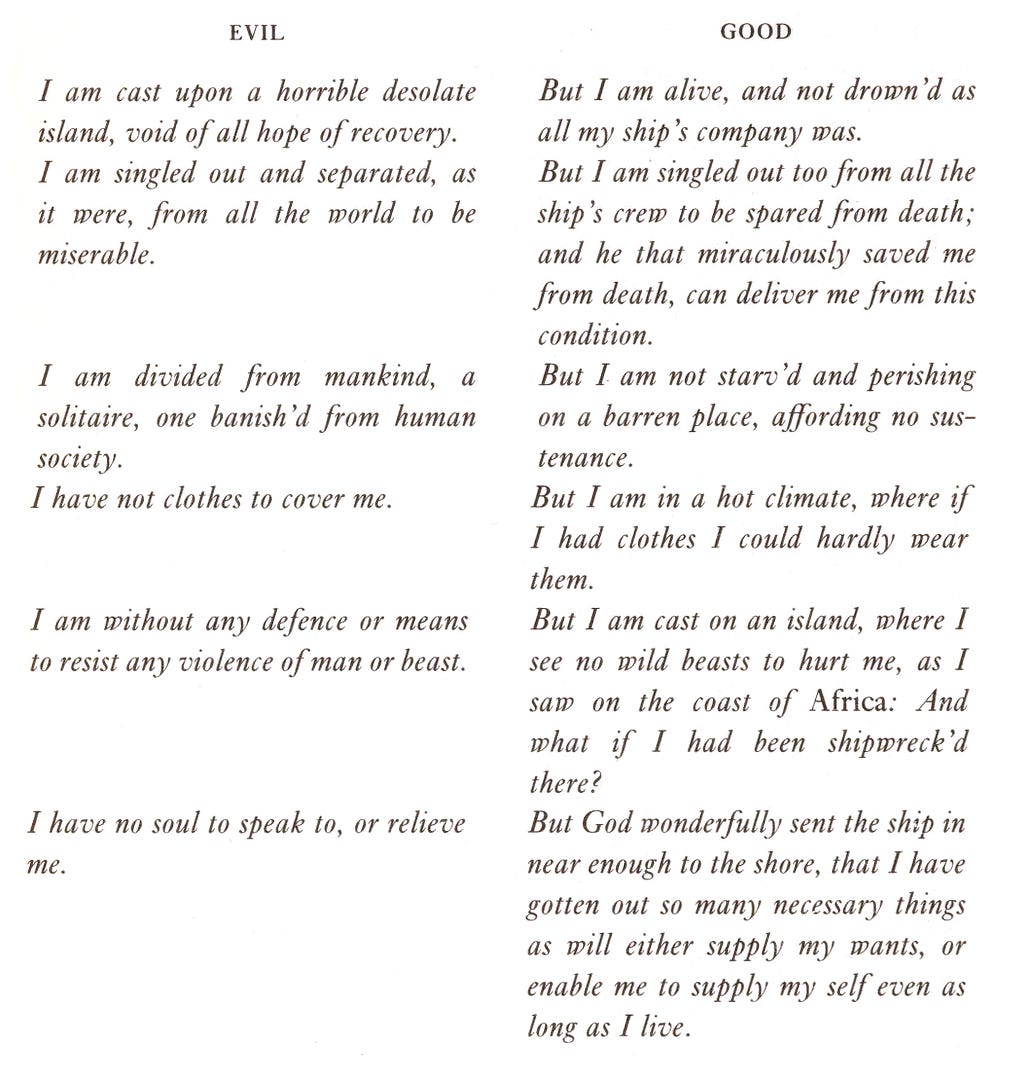
2. Robinson Crusoe’s ‘miseries’ and ‘comforts’, in Chapter 4, his literal desert-island lists:
3. Tristram Shandy’s tolerant list of hobby horses, or ruling passions:
Sir, have not the wisest of men in all ages, not excepting Solomon himself,—have they not had their Hᴏʙʙʏ-Hᴏʀsᴇs;—their running horses,—their coins and their cockle-shells, their drums and their trumpets, their fiddles, their pallets,——their maggots and their butterflies?—and so long as a man rides his Hᴏʙʙʏ-Hᴏʀsᴇ peaceably and quietly along the King’s highway, and neither compels you or me to get up behind him,—pray, Sir, what have either you or I to do with it? (Volume 1, Chapter 7)
4. Ishmael’s ‘systematization of cetology’ (whale lore) in Moby-Dick:
According to magnitude I divide the whales into three primary BOOKS (subdivisible into Cʜᴀᴘᴛᴇʀs), and these shall comprehend them all, both small and large.
I. The Fᴏʟɪᴏ Wʜᴀʟᴇ; II. the Oᴄᴛᴀᴠᴏ Wʜᴀʟᴇ; III. the Dᴜᴏᴅᴇᴄɪᴍᴏ Wʜᴀʟᴇ.
As the type of the Fᴏʟɪᴏ I present the Sperm Whale; of the Oᴄᴛᴀᴠᴏ, the Grampus; of the Dᴜᴏᴅᴇᴄɪᴍᴏ, the Porpoise.
FOLIOS. Among these I here include the following chapters:—I. The Sperm Whale; II. the Right Whale; III. the Fin Back Whale; IV. the Hump-backed Whale; V. the Razor Back Whale; VI. the Sulphur Bottom Whale. (Chapter 32)
And so on, for ten pages.
5. Wilde’s preface to The Picture of Dorian Gray, his tenets of ‘Unreality Hunger’:
To reveal art and conceal the artist is art’s aim. […]
There is no such thing as a moral or an immoral book. Books are well written, or badly written. That is all. […]
No artist has ethical sympathies. An ethical sympathy in an artist is an unpardonable mannerism of style. […]
All art is at once surface and symbol.
Those who go beneath the surface do so at their peril.
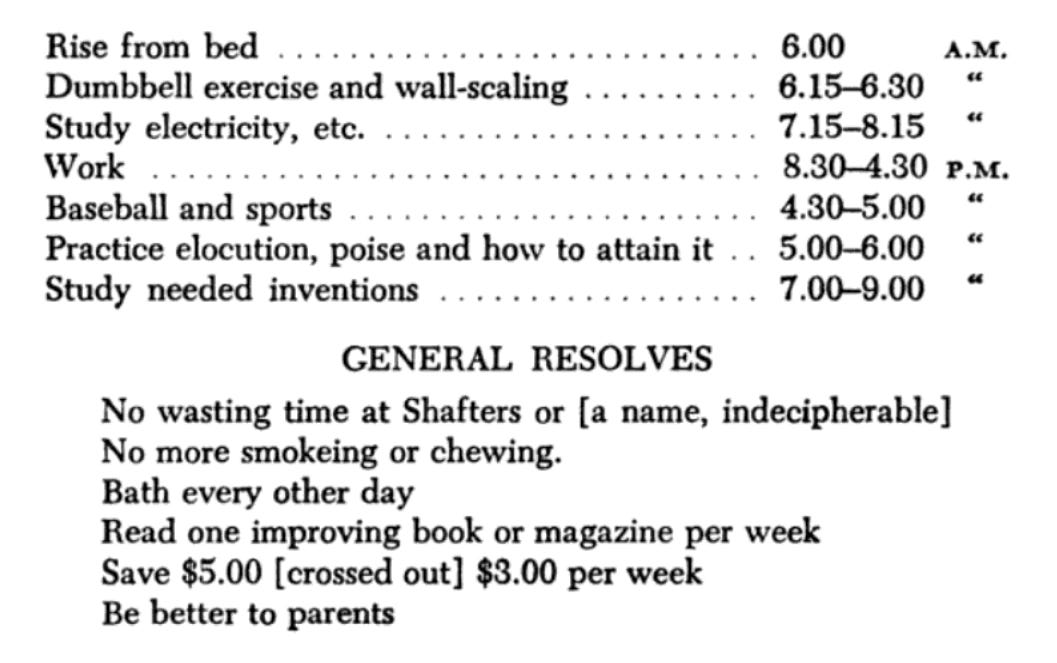
6. Gatsby’s schedule and ‘general resolves’ (Chapter 9):
7. The Seven Commandments of Animal Farm (Chapter 2):
1. Whatever goes upon two legs is an enemy.
2. Whatever goes upon four legs, or has wings, is a friend.
3. No animal shall wear clothes.
4. No animal shall sleep in a bed.
5. No animal shall drink alcohol.
6. No animal shall kill any other animal.
7. All animals are equal.
These, of course, are later replaced by the much more succinct ‘ALL ANIMALS ARE EQUAL BUT SOME ANIMALS ARE MORE EQUAL THAN OTHERS.’
8. Finally, Carol Ann Duffy loves to put lists in her poems. This, from ‘John Barleycorn’ – he being a personification of barley-made beer – is a ‘taberna’, or catalogue of pubs.
He moved through Britain, bright and dark
like ale in glass. I saw him run across the fields
towards the Gamekeeper, the Poacher and the Blacksmith’s Arms.
He knew the Ram, the Lamb, the Lion and the Swan,
White Hart, Blue Boar, Red Dragon, Fox and Hounds.
I saw him in the Three Goats’ Heads,
the Black Bull and Dun Cow,
Shoulder of Mutton, Griffin, Unicorn,
green man, beer borne, good health, long life, John Barleycorn. (19–27)
I said at the start that writing emerged in Mesopotamia around five thousand years ago. A myth relating to this emergence involves Enmerkar, the King of Uruk, and his rival, the Lord of Aratta: ‘In the midst of completing several impossible tasks [before breakfast?], Enmerkar sends a herald with a written message to Aratta. Thus he invents writing’ (The Oxford Companion to World Mythology). In reality, we know that the earliest use of writing was in the making of lists, but I think the myth nevertheless says something profound about why we write anything, even a paean to lists, namely that we always do so in order to send a message of one kind or another.