

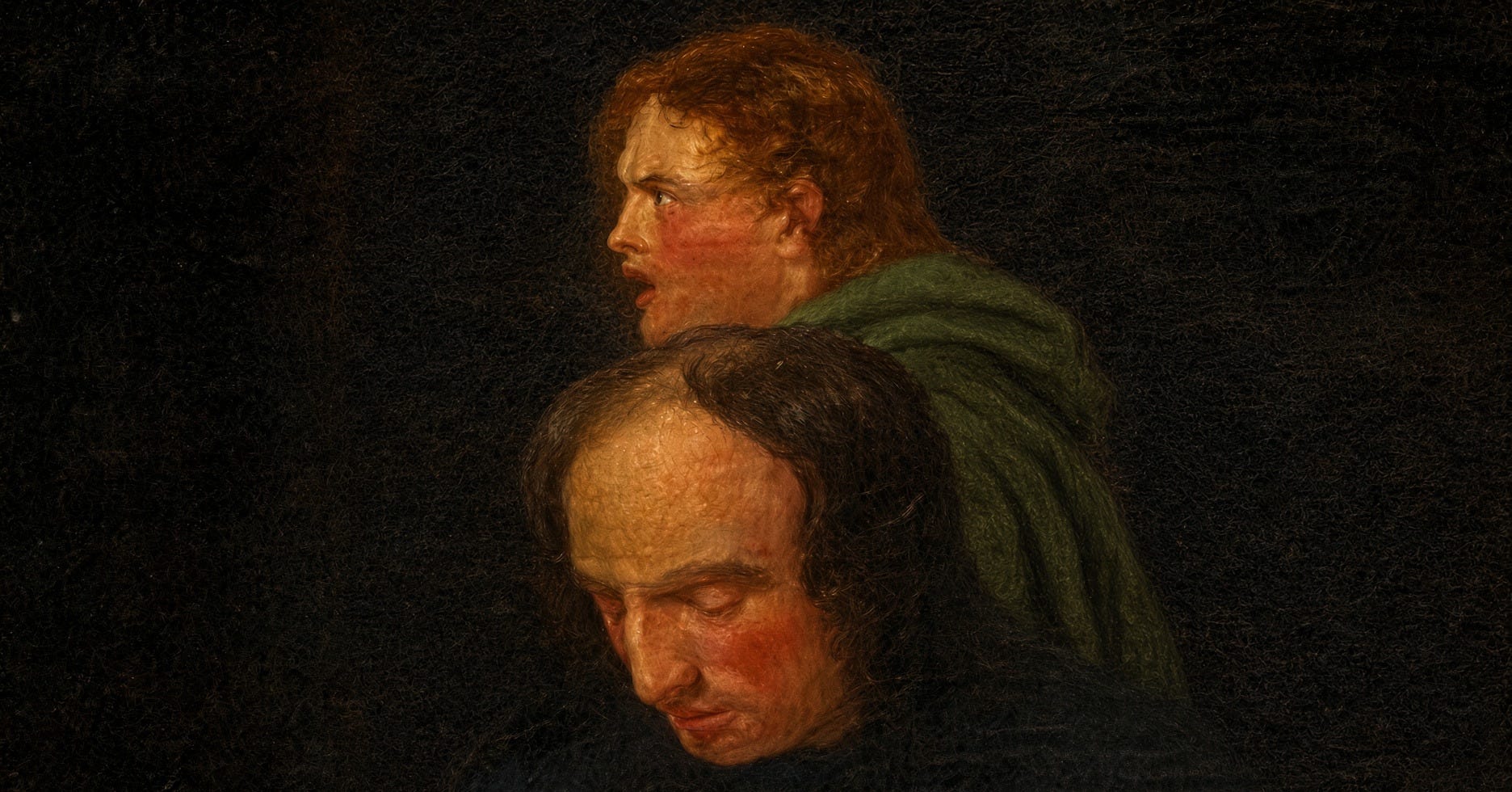
Keats had been introduced to Wordsworth in the autumn of 1816 via The Excursion, Wordsworth’s epic poem and study of, among other things, his own despondency. The only time the two poets met in person was in the winter of the following year, during one of Wordsworth’s trips to London. Keats finished his Endymion – written under The Excursion’s influence – in November, and was excited to meet the master: ‘I am quite disgusted with literary men and will never know another except Wordsworth’.1 In the light of how those meetings went, it is touching and rather sad to read Beth Lau deduce that ‘One impetus to Keats’s continued study of Wordsworth [in autumn 1817] would have been the latter’s impending visit to the capital.’2 The so-called ‘Immortal Dinner’ hosted by Benjamin Haydon on 28 December, at which Keats recited the ‘Hymn to Pan’ from Endymion; Wordsworth’s response, as recorded by Haydon – ‘a Very pretty piece of Paganism’; and Keats’s subsequent references to the older poet’s ‘egotism’, are familiar staging posts in biographies of both men. This story became as prominent as it did because of what Haydon said next: ‘Keats felt it deeply […] he was wounded […] [and] never forgave [Wordsworth]’. But there is now something approaching a consensus that this is misleading.3
Wordsworth’s and Keats’s most well-regarded recent biographers say the following:
Haydon’s report has featured in many indictments of Wordsworth’s alleged egotism, but it is suspect. One version of it is a very late recollection […] another belongs to a period when Haydon had become bitterly hostile to Wordsworth. Currency was given to the story of the slight by Keats’s friend Joseph Severn, but he wasn’t there.
If [it] was the calculated snub that Haydon reports, Keats himself seems not to have noticed and in the weeks ahead would meet Wordsworth at least five times. Quite possibly Keats took Wordsworth’s comment as a compliment[.]4
There is a parallel between Haydon’s ‘wounded’ Keats and the ‘fragile’, critic-sensitive figure depicted in Shelley’s elegy for Keats, ‘Adonais’ – in both cases it was unenthusiastic responses to Endymion that Keats apparently could not handle.5 But in the case of Wordsworth, we should not forget that he was ‘the first major poet to express admiration of Keats’s work’ – he found ‘Great spirits now on earth are sojourning’ ‘vigorously conceived and well expressed’ – and Mary Moorman says that, after the December meetings, ‘[Keats’s] love for Wordsworth’s poetry [was] as deep as ever.’6
However, undeniably there is a ‘never meet your heroes’ element to this story. In February 1818 Keats wrote to his brothers, ‘I am sorry that Wordsworth has left a bad impression where-ever he visited in Town—by his egotism, Vanity and bigotry’.7 He knew who Wordsworth was, whereas Wordsworth did not know he was meeting ‘Keats’, but just some twenty-two-year-old called John, and perhaps did not give Keats the respect we know he deserved. And there were real differences between the two men. I am largely uninterested in immutable characteristics such as social class at birth, and age, but there is also the fact that, unlike Wordsworth and Shelley, Keats was never ‘a Godwin perfectibil[it]y Man’;8 Wordsworth was unbookish, while ‘Keats’s poetry is notable for the extent to which it engages with other texts’;9 ‘While Wordsworth perhaps was “not used to make / A present joy the matter of a song” (Prelude, i: 46–47), Keats’s verse is overwhelmingly occasional’;10 and they had rather different relationships to solitude. But the subject of this essay is the deep affinities in their lives, and more importantly their works and intentions for their works.
Both had good experiences of school. Stephen Gill says that ‘Wordsworth was taught in a humane way’ at Hawkshead Grammar School, and this is true too of Keats at Clarke’s School in Enfield: ‘[His] stay there from 1803 to 1811 gave him a sound education, one which encouraged a tolerant attitude to religion, an interest in the arts, and a liberal political stance.’11 Both later faced similar attacks on their early works. Jerome McGann notes that ‘the attack upon the Cockney School [was] in many respects a repetition of the attack upon Wordsworth’s program in the Lyrical Ballads.’12 Like his hero, Wordsworth, Keats arrived at many of his ‘later’ ideas early. And both were frequently dogged by ‘Money Troubles’, including those relating to inaccessible inheritances.13
However, ‘Nothing so much connects Keats with Wordsworth’, writes Lionel Trilling, ‘as the extent of his conscious commitment to the principle of pleasure.’14 In a letter to John Taylor, Keats said that the ‘Wherein lies happiness?’ passage of Endymion (I. 777–842), ‘set before [him] the gradations of Happiness even like a kind of Pleasure Thermometer—and [was his] first Step towards the chief Attempt in the Drama—the playing of different Natures with Joy and Sorrow.’ This is the passage in which he describes four gradations of happiness, summarised by Miriam Allott as, ‘in ascending order, sensual enjoyment of the natural world […] music […] friendship […] and passionate love’.15
But both poets also measure, in fine detail, the gradations of unhappiness – their thermometers’ negative scales go down to the absolute zero of despondency – and their shared commitment to pleasure is often an antidote to this. Duncan Wu writes that ‘the force that exerted most influence on [Wordsworth’s] poetic life was grief’, and I would suggest this can be said of Keats too, who, like the older poet, had lost both of his parents by his mid-teens.16 Indeed, Leon Waldoff believes that this is the basis for Keats’s affinity to Wordsworth, arguing that ‘a profound sense of loss and of the transient nature of human existence drew Keats inevitably to Wordsworth.’17 Keats’s school friend, Charles Cowden Clarke, recalls that when his mother died, the fifteen-year-old Keats ‘gave way to such impassioned and prolonged grief (hiding himself in a nook under the master’s desk) as awakened the liveliest pity and sympathy in all who saw him.’18 In the wake of their parents’ deaths, Keats and Wordsworth were also both cruelly separated, for years, from their younger, only, and much-loved sisters, and both also lost younger brothers named after their fathers, John Wordsworth and Tom Keats.
These parallels – gradations of despondency and the quest to correct it – persist beyond the early lives of Keats and Wordsworth. That question of Endymion’s that occasioned the ‘Pleasure Thermometer’ letter – ‘Wherein lies happiness?’ (I. 777) – never stops being asked. And I would contend that there are tighter parallels than have yet been identified between Keats’s and Wordsworth’s, and indeed Shelley’s, breakthroughs with regard to that question; that is, between their emergences from ‘crisis’ into their ‘great years’ of despondency-correcting poetic achievement.
Wordsworth’s ‘life-crisis’ (1795) and ‘annus mirabilis’ (1798), are echoed by Shelley’s repetition of the pattern twenty years later: Alastor grew out of a personal crisis in 1815 and his year of greatest productivity began with his finishing the first act of Prometheus Unbound in October 1818. In usually separate discussions of Keats’s and Shelley’s ‘great years’, it is infrequently noted that they are in fact one and the same, namely 1819. More specifically, Keats’s Living Year was defined by Robert Gittings, in his book of that name, as running from September 1818 to September 1819.19 That twelve-month period, says Walter Jackson Bate, ‘may be soberly described as the most productive in the life of any poet of the past three centuries.’20 And what of the ‘crisis’ that preceded it? Keats being Keats, there was not, as it were, three spare years, so the crisis and great year seem to have run consecutively, or even concurrently. Michael Holstein writes,
Sometime after 1817 Keats’s vision of the world darkened. Students of his inner life have emphasized this change as a monumental cataclysm in his life and thought […] This was the period of Tom [Keats’s] sickness and death[.]21
Stuart M. Sperry refers to a ‘period of crisis’ in March 1818.22 But Tom did not die until 1 December. The first poem of the ‘living year’, Hyperion, Keats wrote while nursing his brother. That is, unlike Wordsworth and his ‘silent’ or ‘lost’ period of depression, Keats compressed the crisis–mirabilis movement, writing antidotes to despondency even in its midst. The description of Wordsworth in the ‘Mansion of Many Apartments’ letter – ‘his Genius is explorative of [life’s] dark Passages’23 – is also a self-portrait of the letter writer, subzero on the pleasure thermometer because ‘the World is full of Misery’, but on the threshold of his own year of marvels.
From ‘Despondency Corrected: The “Internalised Quest Romances” of Wordsworth, Shelley, and Keats (1814–22) as Excursions in Pursuit of Happiness’
To Benjamin Bailey, 8 October 1817. Selected Letters, ed. by Robert Gittings (Oxford: Oxford University Press, 2002), p. 26.
Beth Lau, Keats’s Reading of the Romantic Poets (Ann Arbor, MI: University of Michigan Press, 1991), p. 25.
G. M. Matthews, ed., John Keats: The Critical Heritage (London: Routledge, 2005), p. 41.
Stephen Gill, William Wordsworth: A Life, 2nd edn (Oxford: Oxford University Press, 2020), p. 373; Nicholas Roe, John Keats: A New Life (New Haven, CT: Yale University Press, 2013), p. 196.
From Shelley’s preface to ‘Adonais’: ‘The genius of the lamented person to whose memory I have dedicated these unworthy verses, was not less delicate and fragile than it was beautiful’. Everest et al., eds., Shelley: Selected Poems (London: Routledge, 2023), p. 650.
Matthews, ed., p. 41; Mary Moorman, William Wordsworth: A Biography, 2 vols (Oxford: Oxford University Press, 1957–65), II, p. 318.
Gittings, ed., p. 65.
To the George Keatses, 14–31 October 1818 (Gittings, ed., p. 154).
Beth Lau, Greg Kucich, and Daniel Johnson, eds., Keats’s Reading / Reading Keats (London: Palgrave Macmillan, 2022), p. 1.
Jeffrey N. Cox, Poetry and Politics in the Cockney School: Keats, Shelley, Hunt and their Circle (Cambridge: Cambridge University Press, 1998), p. 89.
Gill p. 18; John Barnard, John Keats (Cambridge: Cambridge University Press, 1987), p. 1.
Jerome McGann, ‘Keats and the Historical Method in Literary Criticism’, MLN, 94, 5 (1979), 988–1032 (p. 998).
Keats to B. R. Haydon, 10–11 May 1817 (Gittings, ed., p. 14).
Lionel Trilling, ‘The Fate of Pleasure: From Wordsworth to Dostoevsky’, in Romanticism Reconsidered, ed. by Northrop Frye (New York: Columbia University Press, 1963), pp. 73–106 (p. 80).
Miriam Allott, ed., The Poems of John Keats (London: Longman, 1970), p. 154.
Duncan Wu, Wordsworth: An Inner Life (Oxford: Blackwell, 2002), p. 309.
Leon Waldoff, ‘Keats’s Identification with Wordsworth: Selective Affinities’, Keats–Shelley Journal, 38 (1989), 47–65 (p. 56).
Quoted by Martha Hale Shackford, ‘Keats and Adversity’, The Sewanee Review, 32, 4 (1924), 474–87 (p. 475).
Robert Gittings, John Keats: The Living Year, 21 September 1818 to 21 September 1819 (London: Heinemann, 1954).
Walter Jackson Bate, John Keats (Cambridge, MA: Harvard University Press, 1963), p. 388.
Michael E. Holstein, ‘Keats: The Poet-Healer and the Problem of Pain’, Keats–Shelley Journal, 36 (1987), 32–49 (p. 39).
Stuart M. Sperry, Keats the Poet (Princeton: Princeton University Press, 1973), p. 131.
Gittings, ed., pp. 89–90.